
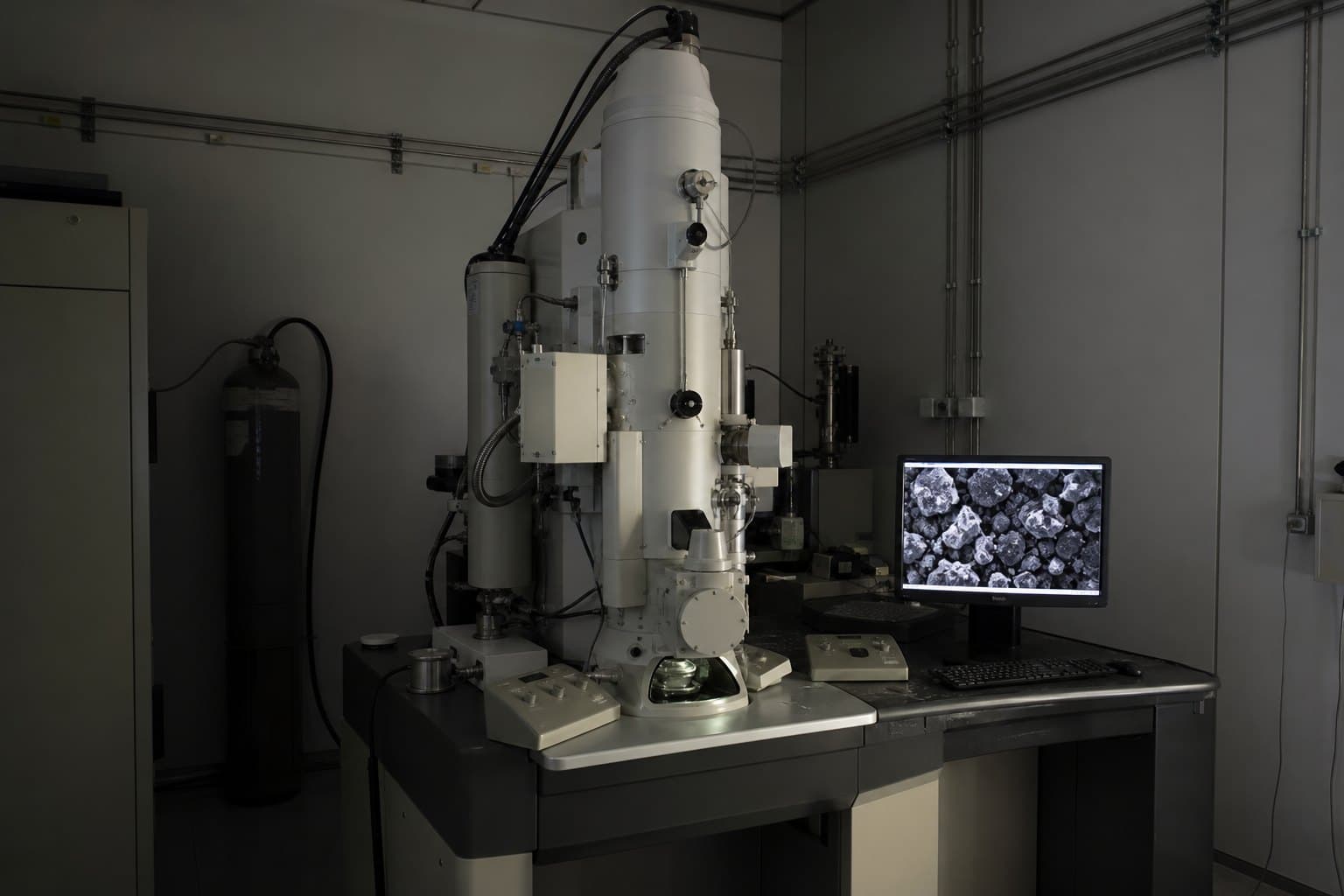
The suite covers conventional and aberration-corrected instruments, with sample preparation that is treated as a craft rather than a footnote.
Typical work packages: failure analysis, coating integrity, and the quiet confirmation that your powder is what you think it is.
The emphasis on preparation is deliberate and worth understanding before commissioning work. In most microscopy the dominant source of variance is not the instrument but the specimen: how it was sectioned, mounted, polished, coated and stored. A beautifully acquired image of a badly prepared sample is a photograph of the preparation, and the suite's staff would rather spend an extra day avoiding that.
Industrial users are well catered for. Reports can be written to a standard that will satisfy a customer or an insurer, and the staff are experienced at framing conclusions carefully when a failure investigation may end up in a commercial dispute.
Specification
- SEM / TEM / FIB capability
- Assisted and independent access
- Industrial reporting on request
- Aberration-corrected transmission instruments
- Energy-dispersive and electron energy loss spectroscopy
- Full metallographic sample preparation laboratory
What it is the right answer to
Jobs this facility genuinely suits.
- Failure analysis on components that passed qualification and then did not
- Coating thickness, adhesion and interface integrity assessment
- Powder morphology and contamination verification for additive manufacturing
- Grain structure and phase identification after process changes
- Confirming that a supplied material is what the certificate claims
What to bring
Turning up without these costs facility hours rather than bench hours.
- Samples with a documented history — where they were, for how long, in what condition
- The specific question, since imaging without one produces attractive and useless results
- Any comparator or reference samples you hold, including known-good ones
- A clear statement of whether the report may be needed in a dispute
What you leave with
- Calibrated imagery with acquisition conditions recorded
- Compositional analysis where requested, with detection limits stated
- A written interpretation distinguishing observation from inference
- Retained prepared specimens for a defined period
Limitations
Worth knowing before you write the proposal.
- Sample size and vacuum compatibility constrain what can be examined intact
- Beam-sensitive and non-conductive materials need preparation that may alter what you wanted to see
- Statistically meaningful conclusions need many specimens, which multiplies cost quickly