
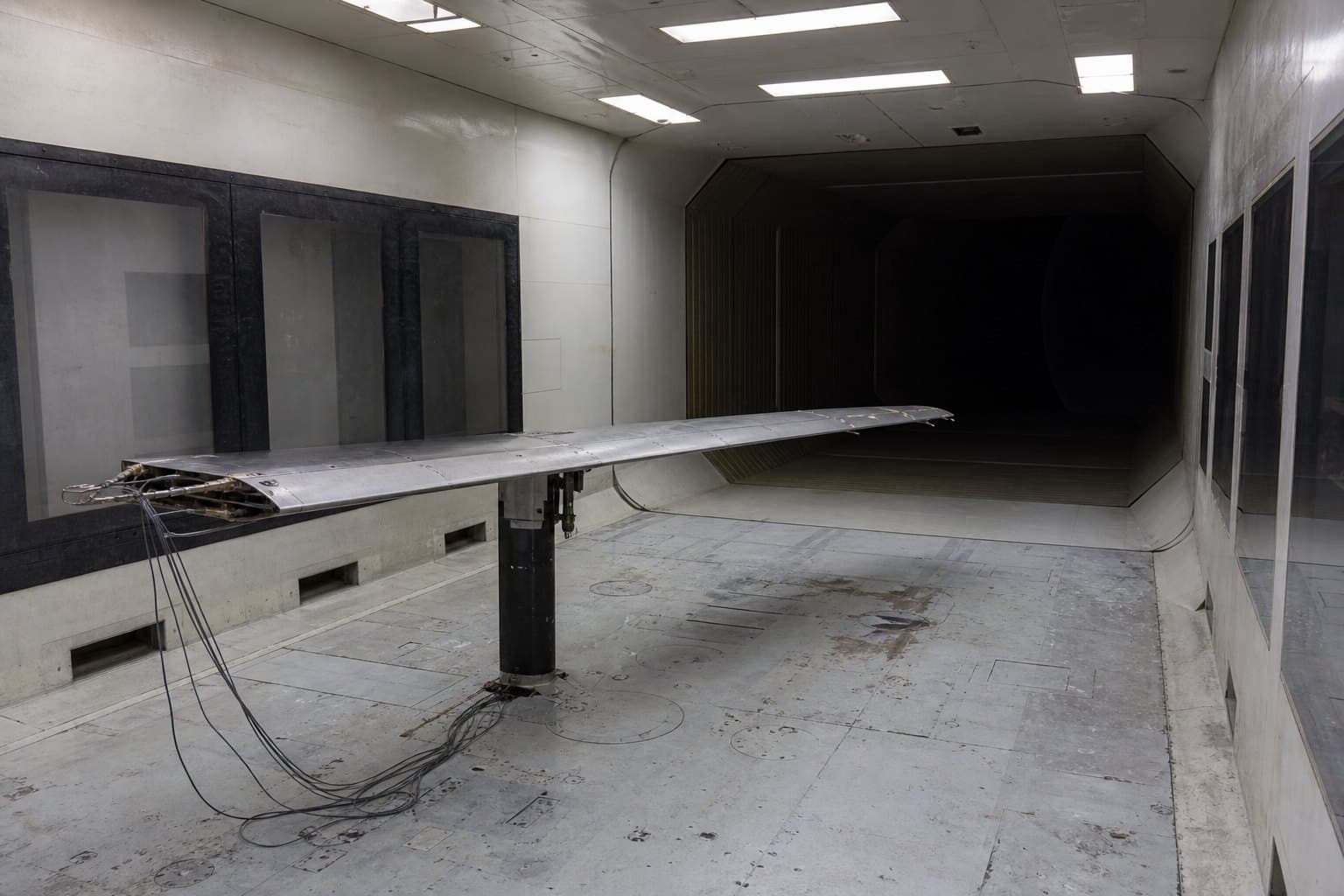
The 5×4 low-speed section is used for aerostructures, ground vehicles and the occasional architectural curiosity. Force balances, PIV and a staff who have seen every bad sting mount.
Industrial users are welcome. Bring a drawing, a load case, and time for a commissioning run.
The commissioning run is not a formality and should be budgeted as a genuine part of the campaign. It establishes the tare, checks the model for the flow-spoiling imperfections that every model has, and reveals whether the mounting arrangement introduces its own aerodynamics. Campaigns that skip it produce data that has to be reinterpreted later, usually by someone less charitable.
The staff are the facility's real asset. They have seen a great many models arrive with surface finish problems, undersized mounts and instrumentation added as an afterthought, and they will tell you about yours before you have paid for tunnel hours to discover it independently.
Specification
- Working section 5 m × 4 m
- Low-speed, closed-return
- PIV and force-balance instrumentation
- Six-component force and moment measurement
- Pressure tapping and scanning capability
- Flow visualisation and smoke systems
What it is the right answer to
Jobs this facility genuinely suits.
- Aerodynamic load measurement on structures and components
- Ground vehicle and pantograph aerodynamics
- Wind loading on architectural and infrastructure models
- Validation data for computational fluid dynamics models
- Flow visualisation for concepts that behave unexpectedly in simulation
What to bring
Turning up without these costs facility hours rather than bench hours.
- A model built to survive the loads, with a sensible mounting interface
- A drawing set and the load case you are trying to establish
- An instrumentation plan agreed with facility staff in advance
- A named engineer who will be present for the whole campaign
What you leave with
- Raw force, moment and pressure data with test conditions logged
- Reduced coefficients against your agreed reference dimensions
- Flow visualisation imagery where requested
- A test report suitable for inclusion in a design substantiation package
Limitations
Worth knowing before you write the proposal.
- Low-speed only — transonic and supersonic questions need a different facility
- Blockage limits mean large models must be scaled, with the Reynolds number consequences that implies
- Instrumentation added after arrival will cost tunnel hours rather than bench hours